„Dimitrie Cupovski“ 13, 1000 Skopje +38923244000 ic@mchamber.mk
„Dimitrie Cupovski“ 13, 1000 Skopje +38923244000 ic@mchamber.mk
.jpg)
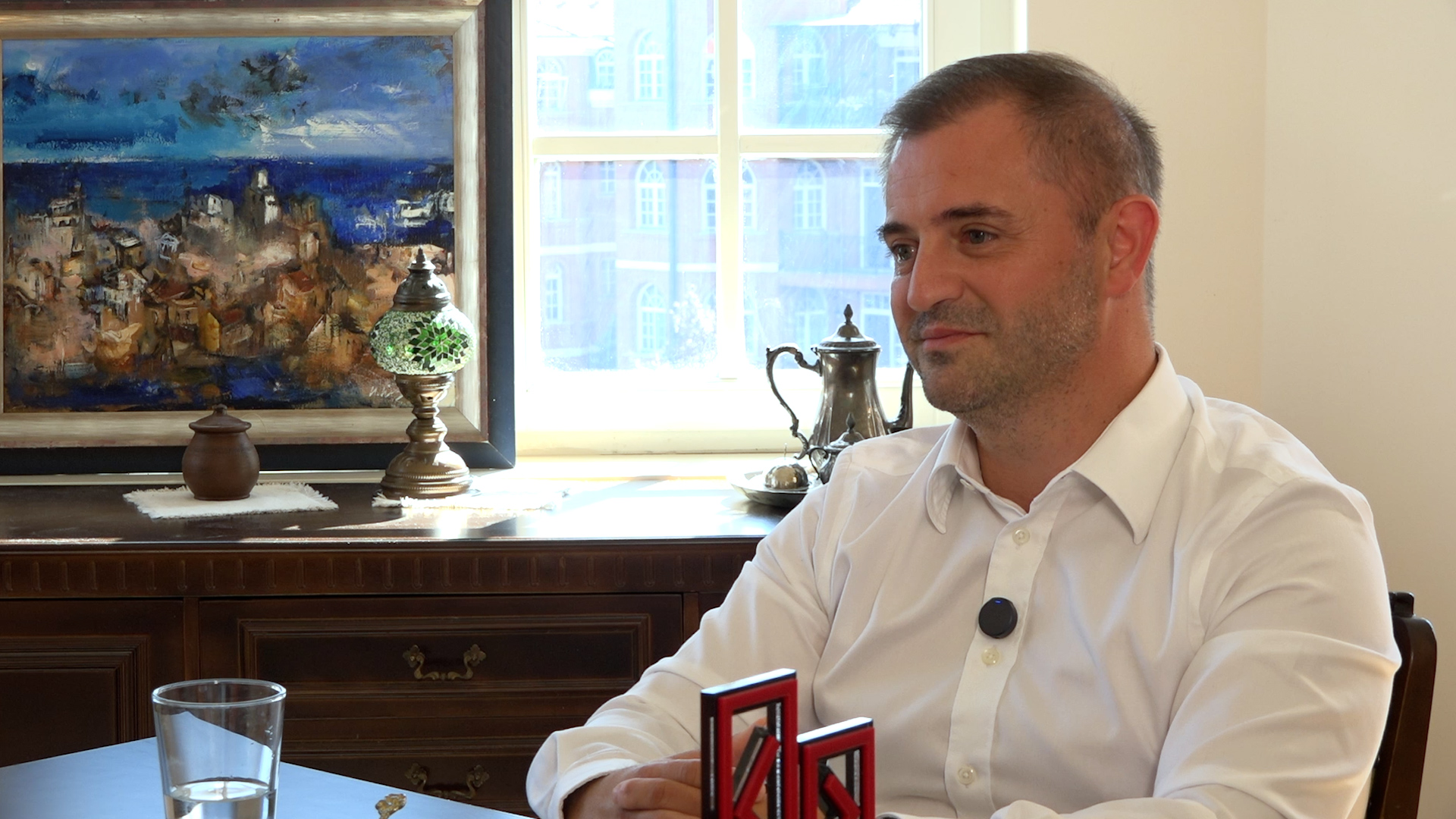
In the latest episode of the Business Club podcast hosted by Branko Azeski, the guest is Kastriot Arifi —Strategy and Development Director at Tikveš Winery AD and M6 Investments, and a member of the Management Board of the Economic Chamber. During the conversation, Arifi shared important insights into the operations of Tikveš Winery AD, its strategies for growth and development, as well as the challenges facing the education system.
Tikveš Winery AD is a brand recognized worldwide, exporting to more than 25 countries across the globe, primarily to the United States, China, Germany, and the United Kingdom, as well as to regional markets — above all Serbia, followed by Bosnia and Herzegovina and Kosovo. By volume and value of wine sold, Tikveš is a leader among wineries, with annual revenues of EUR 60 million and sales of 16 million liters of wine. In Serbia alone, 6 million bottles of wine are exported.
Arifi describes Tikveš not only as a brand, but also as a symbol of Macedonia. He calls working at the company an invaluable experience, especially because of the visionary leadership of Sveto Janevski — founder and principal investor of the M6 Group.
“M6 Group is the holding company, while Tikveš is the brand recognized worldwide, and it is not just a brand, but also a hallmark of Macedonia,” Kastriot Arifi said.
Speaking about his cooperation with Sveto, Arifi describes him as “a great man from whom one can learn a great deal,” because of his knowledge, especially of new technologies and methods, which he selflessly shares with others, offering different paths to overcoming challenges, as well as support for the development and advancement of staff knowledge through training abroad, particularly in London. In 1989, Janevski introduced a unique model of franchise distribution with trucks — a distribution system that does not exist anywhere else in the world — with dedicated employees in the region and beyond.
Arifi portrays Janevski as a great patriot who promotes the Tikveš brand not only in the region, but also globally. Under his leadership, Tikveš has become an internationally recognized brand, with wines winning awards at world exhibitions.
“Tikveš and Sveto are one and the same,” Arifi concluded.
Asked what a company’s strategy means, Arifi explained that strategy is not only operational efficiency, but also a vision for the future — planning activities that enable growth and development of a company, as well as survival in global markets. Strategy should be aimed at overcoming challenges and turning them into success and results.
“One has to be creative — how to deal with all the challenges and how to grow as a company and remain on export markets,” Arifi emphasized.
Speaking about the long-standing idea of a strategic merger of Tikveš (wine production) with Badel (spirits production) and BIP (beer production) for joint distribution, Arifi noted that it is still relevant, while there is also an ongoing process of exploring mergers with other companies.
“The strategy of consolidation and market presence with a diversified portfolio means that we are stronger, more stable, and better prepared for the challenges we will face,” Arifi said.
In the operations of Tikveš Winery AD, distribution does not end with the delivery of the product. The most important thing is to reach the end consumer, in order to obtain information about quality as well as market needs, which enables the development of new products in line with real demand.
Kastriot Arifi was educated within the Macedonian education system, but in his professional career he had the opportunity to work with experienced and skilled professionals, from whom he learned a great deal, working as a consultant at Global Data, country sales manager for Banini from Serbia, regional sales manager, senior business analyst, and sales director at Tikveš Winery AD and M6 Investments.
However, he expressed concern about whether the young generation, which is closely connected to new technologies, will be able to cope with the outdated methods of our education system. He stressed that there is no consistency in education policies, which change with every new minister, and that from independence to today around 20 ministers have been replaced.
According to him, education should focus on skills, critical thinking, media and digital literacy, as well as preparation for working with new technologies and tools. In addition, it should work on retaining young people in the country.




 Прогресив Академија